There’s a common misconception that Japan is one of the most expensive places you can visit. Sure, there are a few specific items that might cost a little more than you might expect, but the truth is that the JPY/USD exchange rate has rendered the ‘Japan is unaffordable’ myth comprehensively busted.
As of September 28th 2026, one US dollar buys you ¥158. Pre-COVID, that figure would’ve been closer to ¥108. That’s almost a 50% rise in the Japanese value of your hard-earned buck.
So why does Japan have a reputation for being expensive?
The Short Answer
There are a few items that are famously expensive in Japan. Taxis, for example, can be much more expensive. The same is true for long-distance rail travel and ski passes. But, these differences tend to be due to the way that Japan’s economy and culture place value on certain services, rather than being an indication of how expensive Japan is as a whole.
These costs can be easily planned for by booking ahead and choosing a good Japan-based tour company to help you get around. One that we spoke to told us that they estimate that tourists get 20-40% better value for their services than they did in 2019, thanks to the more favourable exchange rate.
Aside from travel, there are a few infamous items that can be extravagantly priced (ever bought a single strawberry for over $3?), but we’ll get to those later.
The truth is that if your home currency is US Dollars, British Pounds or Euros, Japan has been getting cheaper and cheaper over the last few years. Everyday spending around Japan gets the average foreign traveller exceptional value for money these days.
Where Your Money Goes Further
Because every single dollar, euro or pound buys more yen than it did back in 2019, everyday expenditure on stuff like food and local public transport is likely to feel cheaper than it does back home.
Food is an area where you can save big money in Japan, so we’ve created a dedicated guide to meal prices in Japan, where you can find out what that bowl of ramen (or convenience store egg salad sandwich) is likely to cost you.
To find out what you need to budget for your specific trip length, check out our Japan Trip Costs guide.
What Costs More Than You’d Expect
Rail Passes

It used to be that a national Japan Rail Pass would pay for itself after a couple of long journeys, by working out cheaper than it would cost to buy tickets individually. However, a huge price hike in October 2023 (when a 7-day pass went from ¥29,650 to ¥50,000) has meant that it now takes a lot more trips to make it worthwhile. A 14-day pass now costs ¥80,000, and a 21-day pass now costs ¥100,000, so it’s worth setting some money aside for this when visiting Japan.
The cost of a Japan Rail Pass can vary greatly depending on where you buy it. From October 1st 2026, agencies outside of Japan charge ¥53,000 for a 7-day pass, whereas the official Japan Rail Pass website still advertises the ¥50,000 price (as of the end of August 2026).
The main takeaway from this: check whether you’d be better off buying individual train tickets before you spend big on a Japan Rail Pass!
Taxis
The cost of taxi fares are standardised in Tokyo, and the prices went up by 10.14% on April 20th 2026. This is where it gets a little bit technical: ¥500 used to get you 1.096km, and it now gets you just 1km, and each ¥100 after that gets you 232m of taxi travel – down from 255m. It may not sound like a big difference, but over the course of the trip, it really adds up! On top of that, taxi fares between 10PM and 5AM are subject to a 20% surcharge.
In simpler terms, a 7km trip across Tokyo in the daytime used to cost ¥2,500, but it now costs ¥3,000. For dramatically cheaper travel, use local trains and subways where you can, and consider ride-sharing where you can’t.
Skiing
Hitting the slopes in Hokkaido isn’t cheap. An adult day pass covering all four Niseko United resorts in peak season costs ¥13,500 in 2026-27, or ¥12,600 in regular season. Again, make sure you’ve factored lift passes into your budget when you plan your trip.
Hotels in Peak Season

Between late March and early May, the price of accommodation can double in Tokyo and Kyoto. That’s because of the immensely popular cherry blossom season, and Golden Week causing big spikes in demand for hotels. This period of the year brings the highest flight and hotel prices of the year.
Fruit (yes, really)
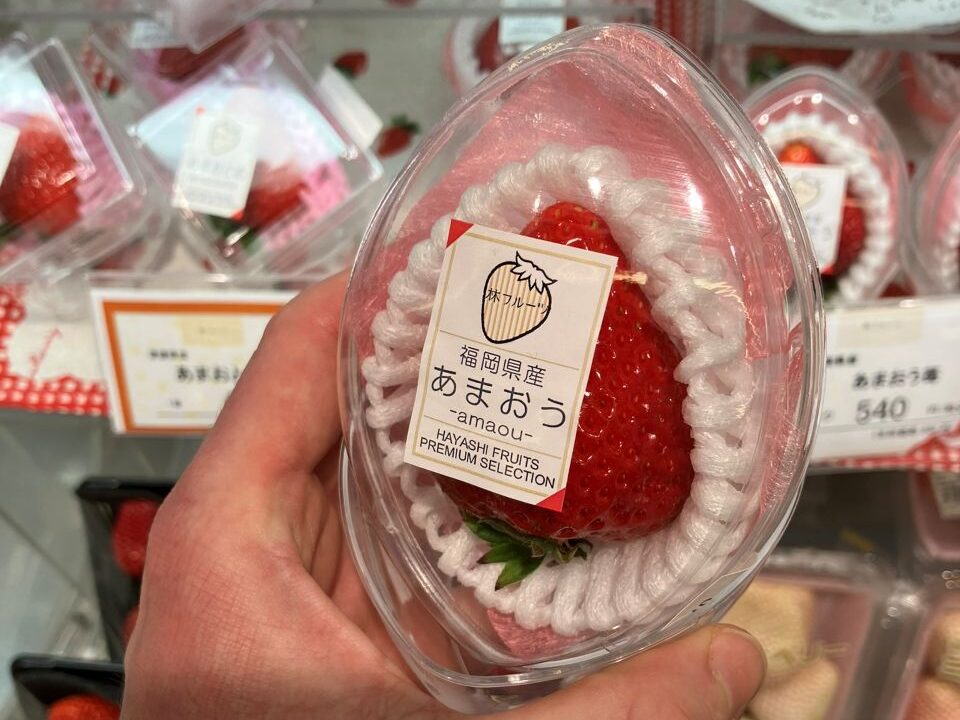
We spotted this Amaou strawberry from Fukuoka on sale for ¥540, or about $3.40 at today’s exchange rate.
In Japan, fruit is more than just a healthy snack. Japanese gifting customs have given rise to the phenomenon of ‘gift fruit’, in which fruit is given as a highly-prized gift item to friends or relatives. These fruits have to be nothing short of perfection, and specialist growers pride themselves on producing the best of the best. In fact, growers of Shizuoka crown melons grow just one melon per vine in climate-controlled greenhouses. This is why it’s not uncommon to see an individual melon or strawberry in protective packaging (and with an eye-watering price tag) in luxury outlets around Japan. At the very top end of the market, a pair of Yubari King melons sold for a record ¥3.2 million in 2018, though that’s not the kind of price you’re likely to see in a shop!
Fruit farms in Japan are quite literally 100 times smaller than those in the US (the average Japanese farm covers 4.7 acres, compared to 490 in the US!), and with over 80% of the country made up of mountainous regions, there isn’t much room for expansion. That means that the fruit that is farmed comes at a price.
These factors mean that a punnet of strawberries typically sells for between ¥600 and ¥1,200, and a bunch of grapes will commonly cost more than ¥1,000. It’s certainly possible to find reasonably priced fruit from convenience stores to farmers’ markets – just make sure you check the price tag before you head to the cash register!
Is Tokyo Expensive?
If you’re planning to visit Tokyo, accommodation is likely to be your biggest expense. Hotel prices have risen sharply in recent times, but vary depending on what time of year you’ll be there. One travel writer who tracked Tokyo hotel prices found that outside of peak season, the average hotel room in Tokyo came in at a pretty reasonable $155 a night. In cherry blossom season, however, you could easily pay twice that.
Getting around Tokyo can be pretty cheap if you stick to trains and subways. Taxis, on the other hand, start at ¥500 for the first kilometre.
If you’re moving to Tokyo rather than just visiting, we have a detailed cost of living guide, which covers rent and monthly bills, and much more.
How to Keep Costs Down
The best thing you can do to cut the cost of your trip to Japan is to travel outside of peak season. If seeing the cherry blossoms isn’t on your bucket list, avoid late March to early May and pay half the price for your hotel.
Next, look at your travel plans. Getting a JR Pass for your rail travel is convenient, but it may not be the cheapest way to get tickets. At ¥50,000 for seven days, it’ll suit you well if you plan to cover a lot of ground, but in many cases it may work out cheaper to buy individual tickets instead – especially if you plan to stick around Tokyo and Osaka. If you do buy one, check the official site’s prices before you buy from an external agency.
Speaking of travel, you’ll save a lot of ¥¥¥ if you catch the last train home. The 20% overnight taxi surcharge means that you’ll thank yourself for getting an earlier night!
Finally, sort out your mobile data before you land. Depending on your provider, roaming costs can stack up quickly when you travel to Japan. A Japan eSIM or pocket WiFi gives you access to maps, train times and much more – and you can unlock even more Japan-only experiences by getting yourself a Japan phone number for the duration of your stay.
So, Is Japan Expensive?
For most people in 2026, no. The weak yen means that you get far more for your money than you did a few years ago, and the costs that hurt are the ones you can plan for. Peak season hotels, taxis, rail passes and ski passes all need a bit of consideration, but if you can plan accordingly and resist the temptation to buy a ¥1 million melon, you’ll be able to keep your costs down – maybe more than you’d expect! So, work out your full budget with our Japan trip costs guide, and get yourself a Japan eSIM to set up before you fly.